Hitachi
Hitachi, as a globally renowned integrated industrial group, has a deep accumulation of technology in the field of refrigeration and air-conditioning, and its refrigeration oil products are widely used in all kinds of compressor systems.
History of Hitachi Refrigeration Oil
Early stage (20th century): Since its establishment in 1910, Hitachi started from the manufacturing of electric motors and gradually became involved in refrigeration technology. 1983, Hitachi invented the world's first scroll air-conditioning compressor, which pushed forward the supporting development of refrigeration oil technology.
At the beginning of the 21st century: Hitachi introduced two-stage oil separation technology to reduce the loss of refrigeration oil in the refrigeration cycle, improving compressor reliability and lubrication efficiency.
Cooperation with global refrigeration oil brands: Hitachi adopts high-end synthetic refrigeration oils such as Emkarate RL, which are produced by CPI, a subsidiary of Lubrizol in the U.S., and are widely used in refrigeration equipment of Hitachi and other international brands.
Innovation under the environmental protection trend: As the global demand for environmentally friendly refrigerants (e.g. R410A, R32) grows, Hitachi refrigeration oils are gradually optimising their formulations to meet the requirements of low GWP (Global Warming Potential) refrigerants.
The characteristics of Hitachi refrigeration oil mainly include the following:
Good compatibility with refrigerants: Hitachi refrigeration oils have good compatibility with HFC (e.g. R134a, R404A, R407C, R410AR, 507, R23, R508A, R508B) and HCFC (e.g. R22, etc.) refrigerants, and are also compatible with CFC refrigerants.
Excellent chemical and thermo-oxidative stability: These refrigeration oils do not decompose easily at high temperatures and resist thermo-oxidative processes, avoiding the formation of carbon and acids, which helps to prolong the service life of the refrigeration system.
Good Electrical Insulation: Due to the good electrical insulation properties of Hitachi refrigeration oils, they can be used safely in a variety of hermetically sealed compressors without leakage.
Low pour point and good viscosity-temperature characteristics: Hitachi refrigeration oils have a low pour point, usually about 10°C below the freezing temperature, which allows them to remain fluid at low temperatures and ensures the efficient operation of refrigeration systems.
Wax-free and less prone to clogging: These refrigeration oils are wax-free and less prone to forming clogs in the system, which is essential to keeping the refrigeration system clean and unclogged.
Environmentally friendly: With the need for environmental protection in mind, Hitachi refrigeration oils are also designed and manufactured with an eye to their environmental friendliness, such as Emkarate RL220H, a synthetic polyol ester (POE) lubricant designed specifically for refrigeration and air-conditioning compressors that use HFC-based refrigerants.
Analysis of the working principle:
(1) Lubrication function
Reducing friction: Refrigeration oil forms an oil film inside the compressor (e.g. bearings, pistons, scroll discs and other moving parts), which reduces direct metal-to-metal contact friction and prevents wear and tear.
(2) Sealing effect
Gas sealing: In piston or screw compressors, refrigeration oil fills tiny gaps, enhances the sealing of the compression chamber, and prevents the leakage of high-pressure refrigerant gas.
(3) Cooling effect
Heat dissipation and cooling: High temperature is generated when the compressor is running, and the refrigeration oil takes away the heat through the circulation to prevent the parts from overheating (e.g. the temperature at the top of the scroll compressor can be more than 100℃).
(4) Cleaning and corrosion prevention
Impurity Carrying: Refrigeration oil adsorbs metal shavings, moisture and acids from the system and removes them through the oil filter.
Rust and oxidation prevention: Additives (e.g. antioxidants) inhibit oil deterioration and corrosion of metal parts.
Workflow (taking scroll compressor as an example)
1. Oil supply by oil pump: After the compressor is started, the oil pump delivers the refrigeration oil to the bearings, scroll disc and other key parts.
2. Lubrication and sealing: Oil film forms a protective layer on the surface of moving parts and seals the compression chamber.
3. Heat exchange: High temperature oil is dissipated through the compressor housing or external oil cooler.
4. Oil separation: The compressed refrigerant-oil mixture passes through an oil separator and most of the oil is recovered to the compressor.
5. System circulation: A small amount of oil entering the pipework is returned to the compressor by refrigerant flow (dependent on system design).
Common Models:
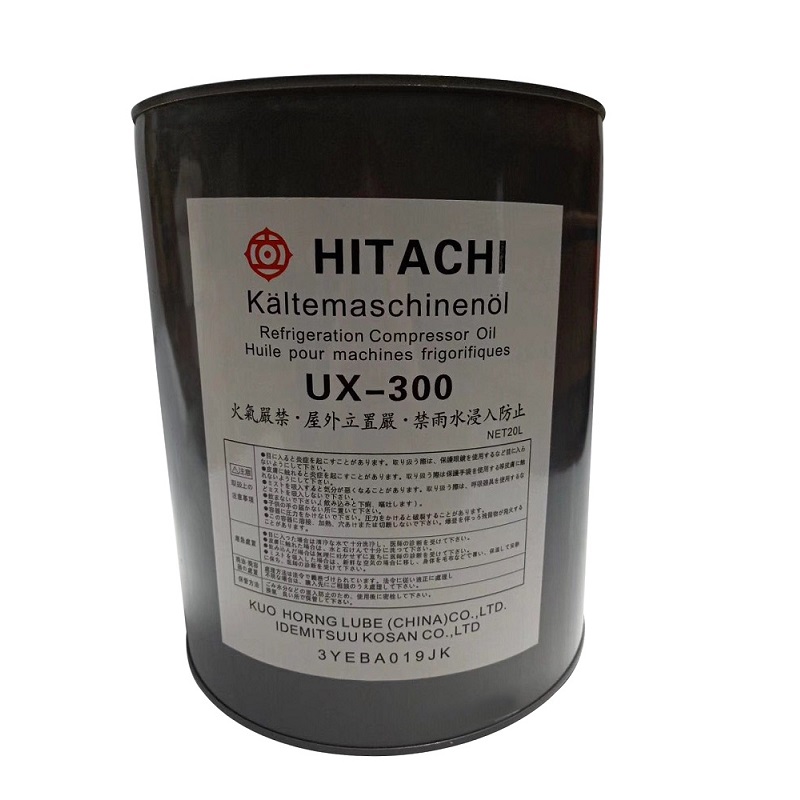
UX-300
Viscosity grade: 32
Viscosity Index (VI): 120-140
Pour Point: < -45°C
Flash point: > 200°C
Density (at 20°C): 0.96 g/cm³
Water content: < 50 ppm
Acid value (mg KOH/g): < 0.05
Oxidation stability (tested at 175°C): < 0.1% precipitate
Refrigerants: R22, R404A, R507
Characteristics:
Wide temperature adaptability, suitable for applications from low to high temperature environments.
Application Scenarios:
Supermarket coolers, refrigerated display cabinets, air conditioning systems and heat pump applications.
FVC-32D
Viscosity grade: 32
Viscosity Index (VI): 130-150
Pour Point: < -45°C
Flash point: > 200°C
Density (at 20°C): 0.96 g/cm³
Water content: < 50 ppm
Acid value (mg KOH/g): < 0.05
Oxidation stability (tested at 175°C): < 0.1% precipitate
Refrigerants:R134a, R407C, R410A
Characteristics:
Excellent antioxidant performance, which can maintain the quality of the oil for a long time and reduce the frequency of maintenance.
Application Scenarios:
Domestic air-conditioning systems, commercial air-conditioning systems, heat pump applications.
BF-32H
Viscosity grade: 32
Viscosity Index (VI): 120-140
Pour Point: < -50°C
Flash point: > 220°C
Density (at 20°C): 0.96 g/cm³
Water content: < 50 ppm
Acid value (mg KOH/g): < 0.05
Oxidation stability (tested at 175°C): < 0.1% precipitate
Refrigerants: R134a, R407C, R410A
Characteristics:
Good compatibility with seal materials:The oil is compatible with common sealing materials (e.g., rubber, plastic, etc.) and will not cause expansion or contraction, thus ensuring system sealing and reliability.
Application Scenarios:
Split air conditioners, window air conditioners, heat pump systems, food processing, cold chain logistics, and freezers and cooling systems in the pharmaceutical industry.
To learn more about Hitachi refrigeration oils. 


