Four order codes sit in the Carrier PP23BZ family. They belong to different chiller lines, run on different refrigerants and, in one case, on a different base oil. The machine model on the nameplate picks the code. The codes on their own do not.
| Machine family | Refrigerant | Oil type | Class | Order code |
|---|---|---|---|---|
| 19XL hermetic centrifugal | HCFC-22 (R-22) | Alkylbenzene | 86, Carrier's own designation | PP23BZ101005 |
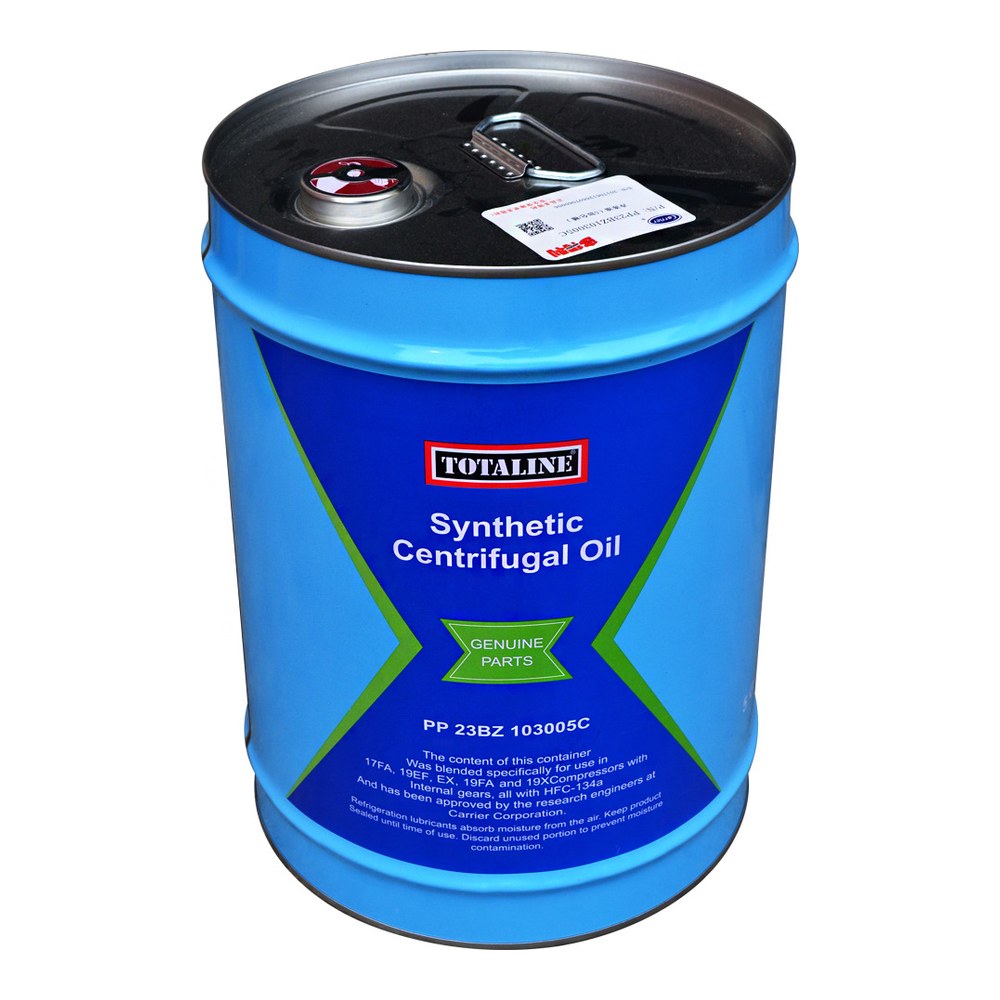
| 19XR / 19XRV centrifugal | HFC-134a | POE, inhibited | ISO VG 68 | PP23BZ103005C |
| 30HXC screw, 06N compressor | HFC-134a | POE | ISO VG 220 | PP23BZ104005 |
| 30HXC / 30XW / 30XA screw | HFC-134a | POE | ISO VG 220 | PP23BZ110005C |
Each row comes from the Carrier document that states the requirement for that machine. The 19XL figure is in the chiller's start-up, operation and maintenance instructions, the 19XR figures are in Form 19XR-2SS, and the 30HXC figures are in that machine's installation, operation and maintenance instructions.
Carrier's start-up, operation and maintenance instructions for the 19XL name the oil as an alkylbenzene-based synthetic compressor oil for HCFC-22 gear-driven machines, give a viscosity grade of 86, and give the orderable part number as PP23BZ101. The order code is PP23BZ101005, built on the base number PP23BZ101.
The grade is where the confusion starts. Carrier states a viscosity grade of 86 and presents it as an ISO viscosity grade. It is not a step in the ISO 3448 series. The standard steps either side of it are 68 and 100.
The difference matters when buying. An oil described as ISO VG 86 and an oil described as ISO VG 68 are not the same oil, and neither label settles whether the pail suits a 19XL. The machine's refrigerant is the part that does: R-22 takes alkylbenzene.
The 19XL instructions also give the oil charge, approximately 11.7 gal (44.3 L) for the compressor. That number is worth having before the quote, because a charge of that size decides how many pails the job takes: at 18.9 L to the pail, one compressor fill runs past two.
Carrier ties this oil to the refrigerant. It is not the oil for the HFC-134a 19XR machines, which take a polyolester in the same family.
The 19XR and 19XRV are HFC-134a machines. Carrier specifies an inhibited polyolester at ISO VG 68, order code PP23BZ103005C, base number PP23BZ103, supplied in 18.9 L pails.
This is the pair that catches people out. The 19XL and the 19XR are adjacent generations of Carrier centrifugal chiller, and a plant that runs both will have two oils on the shelf that look alike and cannot be swapped. The refrigerant changed from R-22 to R-134a, and the oil changed with it from alkylbenzene to polyolester.
The charge on the 19XR is set by compressor frame:
| Compressor frame | Oil charge |
|---|---|
| Frame 2 | 5 gal (18.9 L) |
| Frame 3 | 8 gal (30 L) |
| Frame 4 | 10 gal (37.8 L) |
| Frame 5 | 18 gal (67.8 L) |
There is one more place on a 19XR where the oil is not the oil. The Positive Pressure Storage pumpout unit carries a factory charge of ISO VG 220 POE in its oil separator, and its pumpout compressor is approved for two classes, ISO 220 POE and ISO 68 POE. A 19XR plant therefore holds VG 68 in the main compressor and VG 220 in the pumpout unit, and the two are not interchangeable either. A service that touches both needs two line items, the VG 68 pail and the VG 220 charge, and a stores shelf that keeps them apart.
The 30HXC is a screw machine. Carrier names the compressor as an 06N geared twin-screw unit on R-134a, and names the approved lubricant as Carrier material specification PP 47-32, a polyolester at ISO VG 220.
Two order codes carry that same specification:
The oil class and the material specification are identical. What separates them is the set of machine families each code is listed against, and the 110005C code covers the wider set. If the nameplate reads 30XW or 30XA, the narrower code is not the one to order from.
The charge figures in the 30HXC instructions are per circuit, not per machine: 15 L for circuit A on the 080-190 sizes, and 15 to 30 L per circuit on the 200-375 sizes. A two-circuit machine therefore holds between 30 and 60 L.
Carrier also treats oil condition as a monitored item on the 30HXC rather than a fixed change interval. Oil is added when the level falls, and the oil is analysed as part of maintenance. For a buyer, that changes what to hold: an analysis schedule and a spare pail matter more than a calendar.
ISO 3448 defines a fixed ladder of viscosity bands. It runs 10, 15, 22, 32, 46, 68, 100, 150, 220, 320 and upward. There is no 86 on that ladder.
Carrier's 86 is a designation of its own. Rounding it to the nearest ISO class would produce a number that appears in a catalogue and means something the machine did not ask for. 86 is the identifier Carrier uses for the oil it specifies in the 19XL.
A grade name is not automatically an ISO class. A number that resembles a standard step can still sit between two of them.
The string PP 47-32 appears in the 30HXC literature beside the oil requirement, and it reads like a part number. It is a Carrier material specification. What it identifies is a polyolester oil of the class Carrier approves for the 06N compressor.
Ordering against PP 47-32 as though it were a part number will not produce a pail. The orderable code for the 30HXC is PP23BZ104005. The specification tells you what the oil has to be; the order code tells the supplier what to ship.
The model prefix is the fastest way into the table. Carrier centrifugal chillers in this family carry 19XL, 19XR or 19XRV; the water-cooled screw chillers carry 30HXC, 30XW or 30XA. The refrigerant is printed separately, and it is the field that decides between alkylbenzene and polyolester.
Two other strings on the machine are worth noting before an order goes out. On the 30HXC the compressor is identified as an 06N geared twin-screw unit, and the approved lubricant is given as material specification PP 47-32. On the 19XR the oil charge is set by compressor frame, so the frame number is needed alongside the model to work out how much oil the machine holds.
A plant that has both a 19XL and a 19XR has two refrigerants, two base oils and two order codes in the same machine room. Writing the model on the pail when it arrives is cheaper than discovering the mix-up at a top-up.
| Machine | Code or class | Charge |
|---|---|---|
| 19XL centrifugal | PP23BZ101005 | approx. 11.7 gal (44.3 L), compressor |
| 19XR centrifugal | PP23BZ103005C | 18.9 L to 67.8 L by frame |
| 30HXC screw | PP23BZ104005 | 15 L circuit A (080-190); 15-30 L per circuit (200-375) |
| 30HXC / 30XW / 30XA | PP23BZ110005C | as 30HXC |
| 19XR pumpout unit | ISO VG 220 POE | factory charge, oil separator |
The four base numbers run PP23BZ101, 103, 104 and 110. Two of them differ by one digit, and the machine families they serve often share a plant room. An order that carries a base number without the machine model gives the supplier nothing to check against, because the number alone does not say which machine family it serves.
The model is the field that separates them. Write it beside the part number on the enquiry, and on the pail when it arrives.
All four codes ship in 18.9 L (5 US gal) pails as standard, with further pack sizes confirmed at quotation. A quotation depends on the code, the pack size and the destination port, so the machine model and the order code are what to send first.
Where the plant runs more than one Carrier chiller, it is worth listing them together. A single order carrying the 19XL oil, the 19XR oil and the 30HXC oil usually costs less in freight than three separate ones, and it removes the risk of a pail of the wrong base oil reaching the wrong machine.
PP23BZ101005, an alkylbenzene oil that Carrier specifies for the R-22 19XL hermetic centrifugal machines. Carrier states a viscosity grade of 86 for it, which is Carrier's own designation rather than an ISO 3448 class.
No. PP23BZ103005C is an inhibited polyolester at ISO VG 68 for the HFC-134a 19XR and 19XRV machines. PP23BZ101005 is an alkylbenzene for the R-22 19XL. The refrigerants differ, so the base oils differ, and neither substitutes for the other.
Both are ISO VG 220 polyolester oils to Carrier material specification PP 47-32. PP23BZ104005 is listed against the 30HXC, while PP23BZ110005C is listed against the 30HXC, 30XW and 30XA. The wider machine coverage is the difference.
The 19XR instructions give the charge by compressor frame: 5 gal (18.9 L) for Frame 2, 8 gal (30 L) for Frame 3, 10 gal (37.8 L) for Frame 4 and 18 gal (67.8 L) for Frame 5.
Not in ISO 3448. The standard series steps from 68 to 100 with nothing between them. Carrier's grade 86 is the manufacturer's own designation for the oil it specifies in the 19XL, and it should not be read as an ISO class or converted to one.
---
Copyright & Citation Notice. This article is original content published by QishanrLubricants (Guangzhou Qishanr Technologies Co., Ltd.) at qishanrlubricants.com. Machine assignments, oil types, viscosity classes and oil charges are quoted from Carrier's own chiller documentation for the 19XL, 19XR and 30HXC, and the ISO viscosity series is taken from ISO 3448:1992. Quotation of up to 200 words with attribution and a link to this page is permitted for commercial and technical reference; reproduction in full requires written permission.